Strategic Studies of Culture

Strategic Studies of Culture

Strategic Studies of Culture Journal is a peer-reviewed academic journal published by the Research Center for Culture, Art and Communication. Established in 2008, the journal publishes quarterly issues in both Persian and English, focusing on cultural studies, communication, sociology of culture, and cultural policy.

 Journal Information

 Aims and Scope

The journal aims to:

  • Advance indigenous and strategic knowledge in cultural studies
  • Analyze cultural policies and governance in Iran and globally
  • Promote scholarly discourse in humanities and social sciences

Covered Areas:

  • Cultural Studies
  • Sociology of Culture
  • Media and Communication
  • Cultural Policy
  • Public Culture and Lifestyle

 Peer Review Process

  • All submissions undergo double-blind peer review
  • Review duration: approximately 4 to 6 weeks
  • Final decisions are made by the Editor-in-Chief and Editorial Board

 Article Processing Charges (APC)

  • No fees for submission or peer review
  • Only upon acceptance, a publication fee of 6,000,000 IRR is required
    🔗 Publication Fee Details

 Ethics and Integrity

  • The journal adheres to COPE guidelines and strict publication ethics
  • All manuscripts are screened for plagiarism using professional detection tools
  • Authors must submit an Ethical Commitment Form and a Conflict of Interest Disclosure Form
    🔗 Publication Ethics Policy
    🔗 Conflict of Interest Policy

Indexing and Abstracting

International:

National:


All submitted manuscripts are checked for similarity through Samim Noor software to ensure their authenticity.

Scientific Quarterly of Strategic Studies of Culture ranked "B", in 2023 evaluation of the scientific journals of the Iranian Ministry of Science, Research and Technology. According to ISC (Islamic World Science Citation Center), the journal has achieved an impact factor of 0.333 and Q2 ranking in the year 2021.


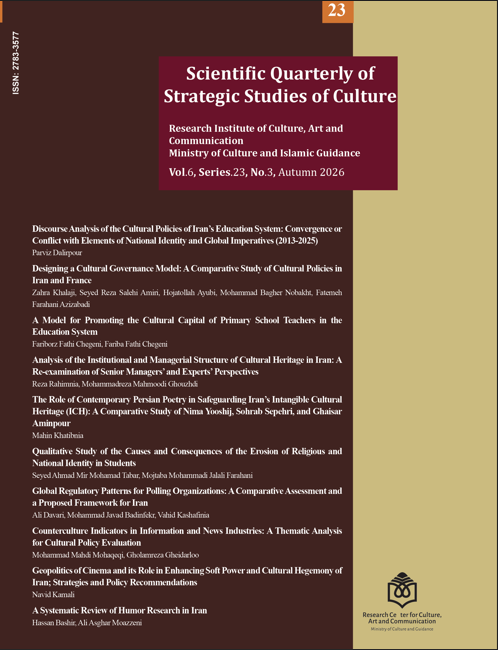
Current Issue: Volume 6, Issue 2 - Serial Number 22, Spring 2026, Pages 9-326 

Keywords Cloud

  • Iran
  • culture
  • Cultural Policy
  • Social Capital
  • Youth
  • Policy making
  • Family
  • National Identity
  • identity
  • Thematic Analysis
  • Cultural Strategies
  • Cultural Industries
  • strategy
  • Ministry of Culture and Islamic Guidance
  • cultural development
  • Grounded theory
  • Social Media
  • Policy Research
  • Instagram
  • public diplomacy
  • Cultural Policymaking
  • Meta-Synthesis
  • Students
  • globalization
  • Education
  • Media
  • Government
  • Political Socialization
  • university
  • Cultural Identity
  • cultural diplomacy
  • Participation
  • Futures Studies
  • content analysis
  • \"
  • Geoculture
  • strategic management
  • Iran\'
  • Meta-analysis
  • Cultural capital
  • Teachers
  • Social participation
  • Economy of Culture
  • Tehran
  • Social vitality
  • Consumerism
  • Policy implementation
  • America
  • Reference Groups
  • Soft power
  • Change of organizational culture
  • lived experience
  • Iraq
  • Radio
  • Phenomenology
  • Social control
  • Lifestyle
  • book reading culture
  • Security
  • Fertility
  • Women
  • Outstanding performance management
  • Talent Management
  • non-native social networks
  • Strategy of human capital
  • Conservation
  • Culture building
  • educational system
  • Social isolation
  • Cyberspace
  • evaluation
  • Public Opinion Research
  • Iranian teenagers
  • Theme analysis
  • Cultural Regionalization
  • Discrimination
  • Arbaeen ceremony
  • Development plans
  • Causal Layer Analysis
  • Shia sociology
  • cultural Geography
  • ontology
  • Intangible Heritage
  • Social Health
  • Recreational Complex\"
  • Mosqueright
  • Religious
  • kmaq Structural Analysis Method
  • Cultural mapping
  • Media policy indication
  • effect size
  • political capital
  • Shahnameh
  • game users
  • virtual ethnography
  • Neo sadraian
  • Job Stress
  • criticis
  • Tataloo
  • Regression
  • Sports management
  • Therapeutic Tourism
  • Book
  • art criticism\"
  • Islamic Unity
  • Civilizing Process
  • elections
  • opportunities
  • Intangible Cultural Heritage
  • Support Vector Regression (SVR) Algorithm
  • Contemporary
  • Key words: mobile phone phobia
  • Gilan culture
  • tv deputy
  • Scenario wizard
  • Imam Khomeini
  • Iranian ethnic groups
  • supreme leader
  • knowledge system
  • challenge
  • Statement of the Second Step of the Revolution
  • Sports events
  • Discourse Analysis
  • Kinship
  • resistant subject
  • Cultural regulation
  • Forecasting of tourism demand
  • educational policies
  • Fertility intentions
  • Job improvement
  • Social tolerance
  • Iranian adolescents
  • Soft War
  • form-content transformation
  • crisis communication
  • Media Management
  • Political Development
  • Disability
  • Health tourism
  • Identity
  • Science language
  • Consequences
  • cultural studies
  • online education
  • mosque  
  • Urban facilities
  • Organizational Efficiency Components
  • Morteza Motahhari
  • emerging media
  • Mosque-centered schools
  • System
  • IRINN
  • . \"
  • future trends
  • Power Distance
  • Ilam province
  • cultural production
  • Tehran City
  • Social Networks
  • Public Sphere
  • Diversity
  • Organizational Culture
  • Social Messenger
  • Hierarchy
  • In - Service Training
  • capital
  • Islamic culture &‌‌‌‌‌‌ guidence ministry
  • Tourism cognitive model
  • Tourism governance
  • Al-Aqsa Murabetat
  • ، Television،
  • Artistic Literacy
  • MACQDA
  • Contextual factor
  • shopping center\"
  • “ National Cultural Values”
  • Art Policymaking
  • Tehrani Students
  • Mohsenaneh Action
  • listening media
  • Women\'s Sports
  • Higher Education Rules and Regulations
  • Keywords: Right
  • policy-making approaches
  • Couples
  • Cultural Quarter
  • Cultural Tourism
  • Memory Politics
  • Kurds of Fili
  • Identity policy making
  • Reform Strategies
  • Suspension functions
  • Media Policy
  • Biosphere
  • Intellectualism
  • official
  • contemporary Iran
  • Leisure
  • middle class trap
  • Qualitative Meta-synthesis